A Comprehensive Guide to Printing and Binding: How to Choose the Right Binding Method?
Sep 02, 2026
When producing printed materials, many people focus solely on paper, dimensions, and color, while overlooking the binding method. With the same content and paper, the wrong binding choice can lead to issues such as difficulty opening, pages falling out, a cheap appearance, or an inability to lay flat; conversely, the right choice not only elevates the tactile quality but also suits the intended use and helps control production costs.
There is no single "best" binding method—only the one that is most suitable.
I. Minimalist Introduction: The Core Selection Logic of Binding
Before understanding specific binding methods, remember these 3 core selection criteria to help beginners avoid mistakes:
1. Consider the number of pages: For thin pages (2-40 pages), choose simple binding; for thick books (40 pages or more), choose hardcover or perfect binding.
2. Consider the purpose: For one-time promotions or temporary documents, choose economy binding; for long-term storage, business gifts, or formal tender documents, choose exquisite binding.
3. Consider the usage requirements: If you need to lay the book flat for easy reading, choose sewn binding or hardcover; if you don't need to read frequently, choose regular perfect binding or saddle stitching.
II. Detailed Overview of Mainstream Printing and Binding Methods (From Budget-Friendly to High-End)
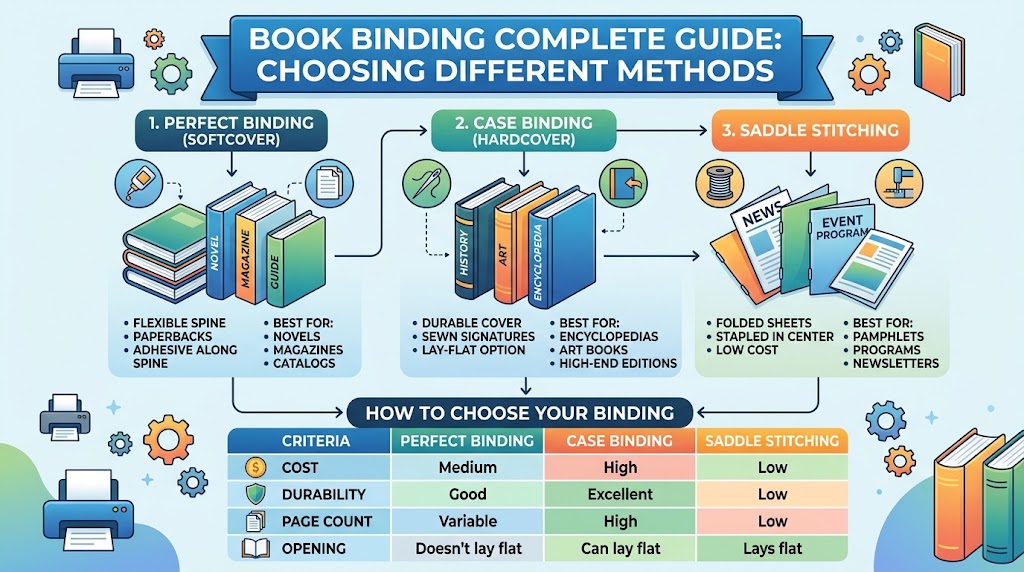
1. Saddle Stitching | The most cost-effective choice for thin booklets
Saddle stitching is the most fundamental and widely used binding method in the printing industry. Its principle is simple: printed sheets are folded in half and secured with two staples along the center fold—a technique named for the way the binding "straddles" the fold like a rider on a horse.
Applicable scenarios: corporate brochures, product manuals, periodicals, student workbooks, event flyers, and exhibition brochures.
2. Perfect Binding | A mainstream, mid-range binding method for business applications
Perfect binding—also known as adhesive binding—is currently the most common method for binding books and document booklets. It requires no wire or thread; instead, the spine of the printed material is ground smooth, coated with a specialized hot-melt adhesive, and bonded to the cover to form the finished product. The result is a clean, neat appearance free of visible binding marks.
Suitable for: Bid documents, academic theses, training manuals, educational supplements, corporate brochures, general books, and product manuals.
3. Thread-Sewn Perfect Binding | An Advanced Binding Method Offering Superior Durability
Thread-sewn perfect binding is an upgraded version of standard perfect binding and represents a premium binding technique. Individual folded signatures are first stitched together with thread to form a secure book block; a hot-melt adhesive is then applied to attach the cover. This method combines the structural integrity of thread binding with the clean, sleek appearance of perfect binding.
Applicable scenarios: high-end picture albums, fine books, teaching materials, classic manuals, long-term professional materials, and art collections.
4. Hardcover Binding | The Premier Choice for a Premium Business Look
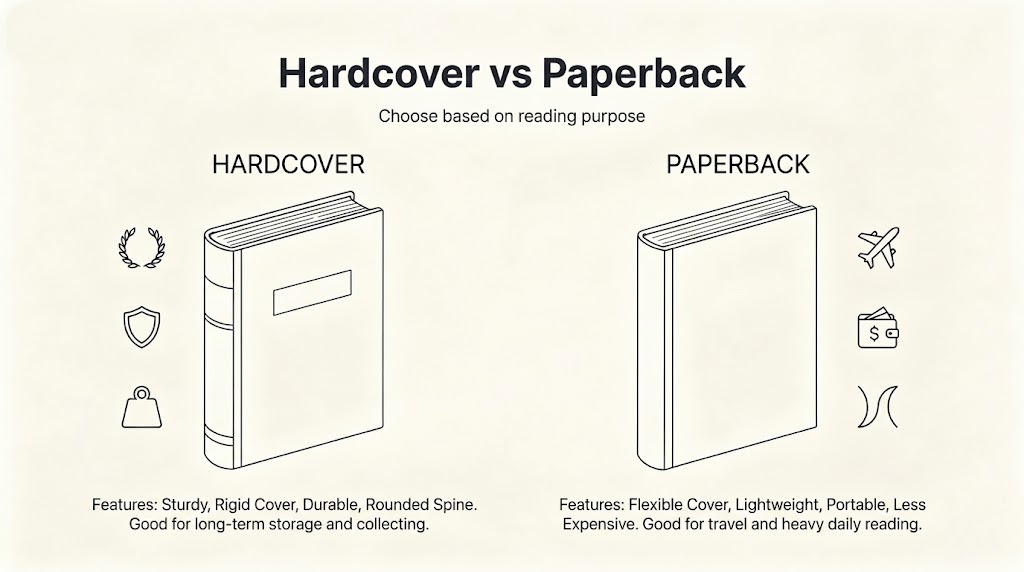
Hardcover binding is a high-end finishing technique available in two main forms: sewn hardcover (the industry standard) and adhesive-bound hardcover. It is characterized by a rigid cover—typically constructed from cardboard wrapped in materials such as coated paper, specialty paper, or leather—and interior pages that are usually sewn-bound. This process involves complex craftsmanship and delivers a premium feel. Common styles include round-spine and flat-spine hardcover.
Suitable for: Corporate annual reports, high-end brand brochures, commemorative albums, school anniversary albums, collector's editions, business gift books, premium tender documents, and portfolios.
5. Wire Ring Binding | A practical office binding method that can be repeatedly disassembled and reassembled.
Wire ring binding, also known as double wire binding, involves punching holes on the side of the paper and inserting a double metal wire to fix it into a book. The wire can be opened and closed flexibly, making it an essential binding method in office settings.
Applicable scenarios: resumes, reports, tender documents, study materials, desk calendars, wall calendars, notebooks, recipes, drawing manuals.
6. Thread-bound | A classic Chinese-style binding with a retro feel.
Traditional handmade thread-bound books are a classic Chinese binding technique. They do not require glue or nails, and are bound with pure cotton thread by hand. The pages are flat, the binding is simple and elegant, and they have a strong Chinese cultural flavor.
Ideal for: Facsimiles of ancient texts, poetry and art albums, calligraphy collections, commemorative books with a traditional Chinese theme, cultural and creative publications, and manuals on traditional culture.
III. Avoiding Common Pitfalls in Binding Selection
1. Forcing a binding method unsuitable for the page count: Avoid saddle stitching for booklets exceeding 40 pages, as excessive thickness causes bulging, page bursting, or misaligned binding; conversely, using standard perfect binding (adhesive binding) for thick volumes often leads to the glue failing and pages falling out over time.
2. Mismatching the binding to the usage scenario: Using simple plastic or wire-O binding for high-end brochures or business proposals cheapens the overall quality; conversely, using hardcover or Smyth-sewn binding for routine, temporary documents results in wasted budget.
3. Overlooking the need for the book to lie flat: Brochures, picture books, and study materials often require a flat-opening format for easy reading; prioritize Smyth-sewn, hardcover, or wire-O binding to avoid the issues associated with standard perfect binding, where the book cannot lie flat and content near the spine becomes obscured.
4. Spine design errors: Saddle-stitched booklets do not have a spine, so no spine text is required; for perfect binding or hardcover, the spine dimensions must be calculated based on the book's thickness to prevent text from appearing cramped or blurry.
IV. Quick Selection Summary Table
Saddle stitching (best value for money)
Booklets and promotional materials (2–40 pages)
Standard perfect binding (versatile for everyday use)
Standard documents and business brochures (40–400 pages)
Smyth-sewn perfect binding (enhanced durability)
Thick volumes, frequently read materials, and high-quality publications
Hardcover binding (premium look and feel)
High-end displays, collector's editions, and business gifts
Wire-O binding (durable and detachable)
Office documents requiring disassembly or repeated revisions
Traditional thread binding
Traditional-style creative products and classic literary works
V. Conclusion
Binding is by no means a mere appendage to the printing process, nor is it a finishing step to be treated casually; rather, it is a critical factor that spans the entire lifecycle of the finished product, directly determining its quality, usability, and durability.
From the moment a printed book is delivered to a reader, the binding takes on multiple responsibilities: carrying the content, protecting the inner pages, supporting the reading experience, and even extending its lifespan. The sturdiness of the binding determines whether the book remains flat and firm after repeated readings and is not prone to falling out or falling apart. Whether the binding method is suitable for the usage scenario determines whether the reading experience is smooth and natural. Whether it lays flat smoothly, whether it is easy to flip through, and whether it is easy to store are all seemingly minor experiences that are often quietly determined by the binding process.
It can be said that binding is not only a physical "assembly", but also the last checkpoint for quality commitment.
Read More