Popular Science about Printing: From Millennia-Old Wisdom to Modern Technology
Aug 20, 2026
Printing is the technology of transferring information such as text and images onto paper or other media using a printing plate. It is not merely an industrial process but a vital engine driving the transmission of human civilization and the dissemination of information. From ancient woodblock printing to modern digital printing, the history of printing technology is a history of the popularization of human knowledge.
The long-standing wisdom of printing
China is the birthplace of printing. As early as the Tang Dynasty, woodblock printing was invented. Craftsmen would carve the entire page of text backwards onto a wooden block, brush it with ink, cover it with paper, and then print out pages with black text on a white background. During the Northern Song Dynasty, a commoner artisan named Bi Sheng invented movable type printing; by creating individual characters from clay, arranging them for printing, and then dismantling them for reuse, he vastly improved efficiency and ushered in a new era in the history of printing. Subsequently, wooden and metal movable type technologies were developed. In modern times, the laser typesetting technology for Chinese characters invented by scientist Wang Xuan has enabled the Chinese printing industry to bid farewell to "lead and fire" and enter the era of "light and electricity".
The Four Major Basic Modern Printing Processes
Letterpress printing: the oldest printing method, where the images and text on the printing plate are raised. During printing, ink is applied to the raised surface and pressed onto the paper. Its characteristics include clear printing and rich ink color, and it is often used for label and packaging printing.
Gravure printing: In contrast to relief printing, the image and text areas are recessed. During printing, the grooves are filled with ink. After scraping off the excess ink from the surface, the ink in the grooves is transferred to the substrate under pressure. Gravure printing has a thick ink layer, strong color expression, and high printing durability, and is often used for high-end picture albums, banknotes, and plastic packaging.
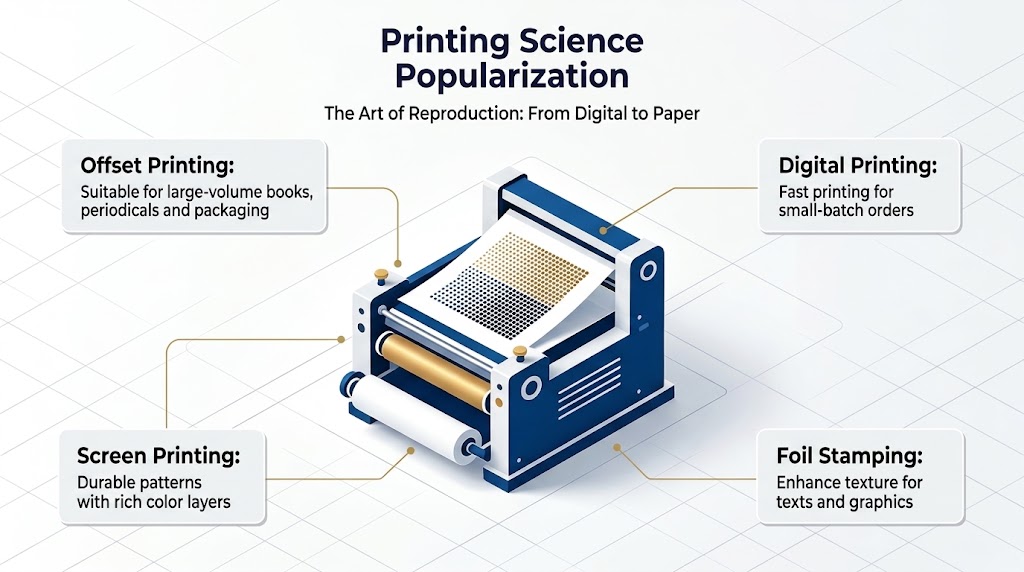
Offset printing: also known as lithography, is currently the most widely used printing method. It utilizes the principle of "oil and water are immiscible", where the image and text areas on the printing plate are attracted to ink, while the blank areas are attracted to water. During printing, water is applied first, followed by ink. Only the image and text areas are coated with ink, and then the ink is transferred to the paper using a rubber blanket. Most of the books, newspapers, and magazines we see every day use this process.
Screen printing: also known as silk screen printing, the printing plate is mesh-like, the mesh of the image area can pass through ink, while the blank areas are blocked. During printing, a squeegee forces the ink through the mesh openings onto the substrate. It is highly adaptable and can be printed on various materials such as paper, plastic, metal, and fabric. It is commonly used for T-shirts, posters, and circuit boards.
Basic Knowledge of Modern Printing Design and Technology
Color Mode: Design files must use the CMYK color mode (Cyan, Magenta, Yellow, Black), which is the standard for four-color printing inks. RGB is a screen display mode; using it directly for printing will result in significant color discrepancies.
Bleed Settings: A "bleed" area of approximately 3mm is typically required around the edges of the design. This prevents white edges from appearing on the finished product due to minor cutting inaccuracies.
Black text processing: For small-sized black text, it should be set to single-color black (C0 M0 Y0 K100), and avoid using four-color black (CMYK all have values) to prevent misregistration that could cause blurry text or ghosting.
Post-printing processes: Processing after printing can greatly enhance the quality of the product. For example, lamination can protect printed materials and increase gloss; UV varnishing can make local graphics and text crystal clear; embossing and debossing can create a three-dimensional tactile effect; and die-cutting can cut paper into various irregular shapes.
Printing is a comprehensive craft that integrates science, technology and art. From the ingenious carvings of a thousand years ago to today's intelligent digital printing, it has been constantly evolving, delivering our thoughts and creativity to every corner of the world in a more efficient, environmentally friendly, and exquisite way.
Read More