A Comprehensive Guide to Factory-Customized Children's Picture Books: Craftsmanship, Standards, Processes, and Industry Realities
Sep 30, 2026
With the upgrading of personalized parenting, campus cultural and creative products, and corporate gift markets, factory-customized children's picture books have transformed from a niche demand into a mainstream choice. Many parents, organizations, and businesses struggle to distinguish between picture books customized by small, private workshops and those produced by professional factories. Why do picture books with the same appearance have such huge differences in price, quality, and safety?
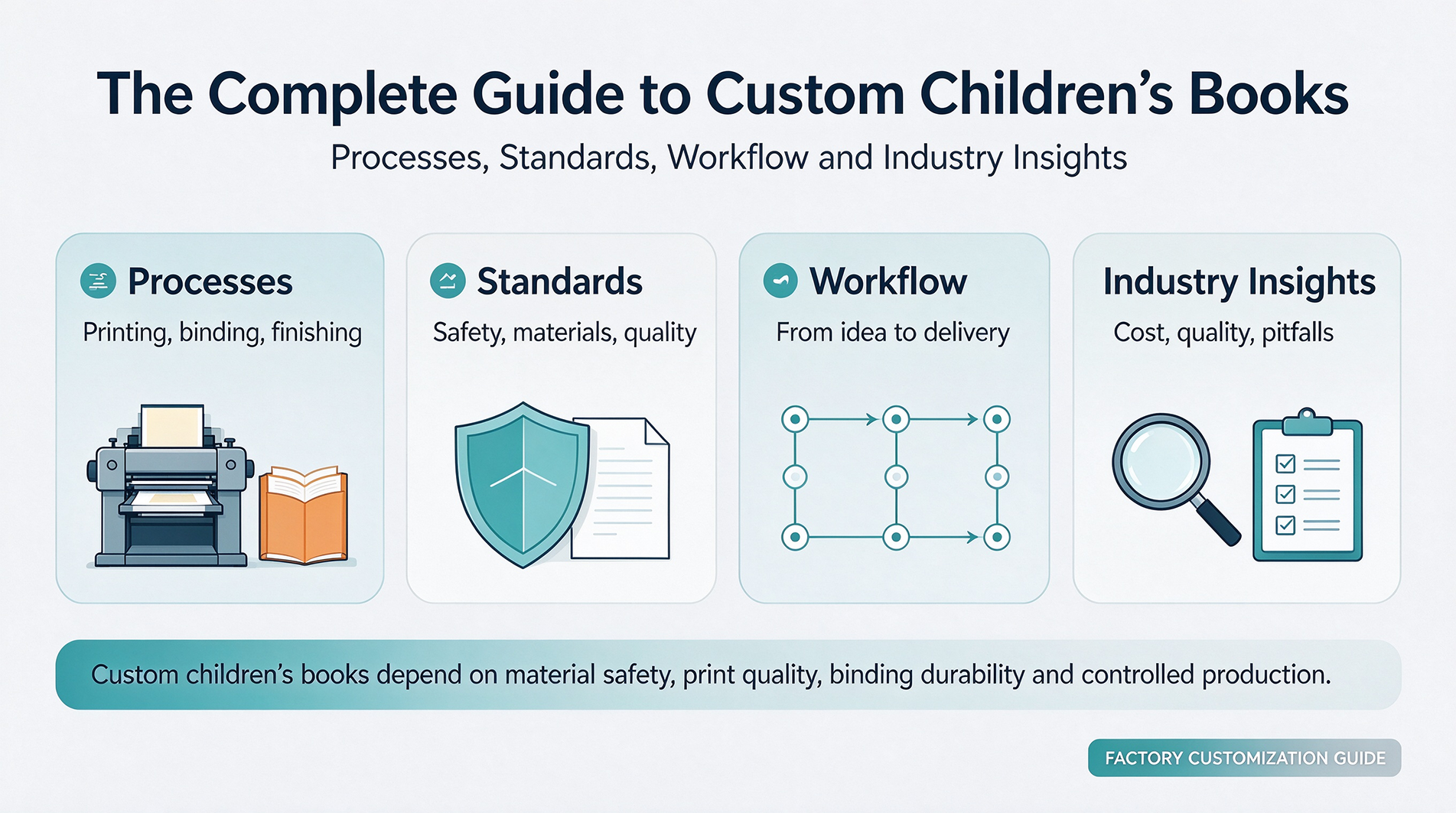
This article provides an industry-wide overview of the core knowledge behind factory-customized children's picture books, covering industry definitions, production standards, process differences, complete customization process, applicable scenarios, and tips for avoiding pitfalls, helping readers fully understand standardized factory-customized picture books.
I. What are factory-customized children's picture books?
Factory-customized children's picture books refer to a standardized, end-to-end service provided by professional printing facilities—covering everything from content design, original illustration, layout and proofreading, and material selection to printing, binding, and final delivery. Unlike personal DIY projects or small-scale workshop printing, factory customization offers certified production capabilities, mature manufacturing techniques for children's books, and adherence to safety standards for materials. It supports both small-batch customization and large-scale mass production, catering to the diverse needs of individuals, kindergartens, educational institutions, and corporate groups.
Its core features include exclusive content, customizable production processes, traceable quality, and guaranteed safety; it enables the creation of unique, personalized storybooks for individual children while also supporting the mass production of themed, school-specific, or public-service picture books, making it the most professional and reliable custom picture book service currently on the market.
https://www.jinxuprint.com/product/custom-hardcover-children-picture-book-kids-story-book-printing
II. Factory Customization vs. Small-Workshop DIY
Many people mistakenly believe that customized picture books are just "printing and binding". In fact, children's picture books belong to children's publications and have strict requirements for materials, inks, processes and edge treatment. The finished products from factories and small workshops are worlds apart.
1. Differences in safety materials (most critical)
Reputable picture book manufacturers utilize food-grade white cardstock, FSC-certified paper, and eco-friendly soy-based inks—ensuring the products are free from odors, formaldehyde, and heavy metals while complying with national safety standards for children's books and EN71 safety regulations for children's products. For board books designed for young children, 300-600g thickened and wear-resistant cardboard is used, which is tear-proof, water-proof, and can withstand repeated reading.
Small workshops often use ordinary printing paper and inferior chemical inks, which have a pungent odor, thin paper, and ink bleed and fade. Young children may bite or touch these materials, posing health risks.
2. Differences in printing processes
The factory employs professional four-color offset printing and high-definition color reproduction technology; the illustrations feature rich, soft colors that are true-to-life and gentle on the eyes, perfectly suited to children's visual development. It also supports fine processes such as lamination, hot stamping, UV coating, and embossing, resulting in exquisite and high-quality images.
Small workshops mostly use digital printing, resulting in serious color distortion, blurry images, and heavy graininess, which can easily cause visual fatigue in children if they read for a long time.
3. Differences in workmanship details
The factory's standardized production will be uniformly cut with rounded corners, without sharp corners, to prevent scratching children's little hands; the binding adopts professional processes such as thread-locking glue binding, hard-shell hardcover, and frame binding, which is firm and does not open pages, does not come off, and is durable and durable.
Most of the small workshops use right-angle cutting and simple binding, with sharp corners and loose binding, which can easily cause pages to fall out and be damaged, posing safety risks.
4. Compliance and After-Sales Gaps
Legitimate factories can provide quality inspection reports and material certificates, ensuring that bulk orders of picture books meet compliance standards for public use in schools and institutions; in contrast, small, unlicensed workshops lack certifications and quality inspections, resulting in finished products that offer no safety guarantees or after-sales support.
https://www.jinxuprint.com/product/custom-printed-childrens-storybooks-bilingual-paperbacks-for-reading-and-learning
III. Popular Science on Mainstream Materials and Craftsmanship of Factory-Customized Children's Picture Books
Factory customization allows for the flexible combination of materials and manufacturing techniques based on the child's age, usage scenario, and budget; the common mainstream types fall into three categories:
1. Board Books for Toddlers (Ages 0–3)
Designed specifically for young infants and toddlers, this book is made of thickened cardboard that is waterproof, stain-resistant, tear-resistant, and bite-resistant. The entire book has rounded corners for maximum safety, making it suitable for babies to flip through independently every day. It is also the first choice for a family's exclusive commemorative picture book.
2. Hardcover Picture Book (Ages 3–8)
Made with the same craftsmanship as mainstream high-end picture books on the market, featuring a hard cover, sewn binding, and high-definition full-color printing. It has a substantial and exquisite texture, is not easily deformed, and is suitable as a birthday gift, a coming-of-age gift, or a school commemorative picture book. It can be collected and preserved for a long time.
3. Paperback perfect-bound picture book (Ages 6+ / for bulk use)
It offers excellent value for money, with thin, smooth paper, clear colors, and sturdy binding, making it suitable for mass production of kindergarten-themed picture books, customized classroom books, corporate charity picture books, and event gifts.
IV. Complete Standardized Process for Factory-Customized Children's Picture Books
Custom manufacturing at a legitimate factory follows a mature, standardized process—fully controllable, verifiable, and modifiable—to ensure the final product meets expectations and prevent costly failures.
Step 1: Requirement Alignment – Confirm the customization type (personalized for an individual vs. themed batch production), dimensions, page count, materials, quantity, and target age group; clarify the story theme and core requirements.
Step 2: Content Creation – Personalized picture books can incorporate the child's name, physical appearance, and family details into an original story script; batch-produced books feature tailored copy based on themes such as school, corporate, or educational topics.
Step 3: Illustration – Professional artists create original, hand-drawn illustrations suited to a child-friendly aesthetic—soft, playful, and free from copyright issues associated with stock images.
Step 4: Layout and Proofreading – Professional typesetters adjust fonts, line spacing, and image-to-text ratios to suit children's reading habits, while multiple rounds of proofreading ensure accuracy regarding text, visuals, and details.
Step 5: Proofing and Confirmation – For batch orders, a physical sample is produced first; mass production begins only after the client confirms the colors, craftsmanship, and content are correct.
Step 6: Mass Production and Quality Control – The factory initiates mass production, with comprehensive quality checks covering color consistency, binding integrity, edge finishing, and cleaning (dust/stain removal) to eliminate defective items.
Step 7: Packaging and Shipping – Standardized packaging provides protection against moisture and pressure, ensuring the finished products are delivered in perfect condition.
https://www.jinxuprint.com/product/customized-childrens-board-books-interactive-early-education-board-books-designed-specifically-for-toddlers
V. Core Advantages and Application Scenarios of Factory-Customized Picture Books
Core Advantages
1. Safety & Compliance: Meets child safety standards for all materials and is free from harmful substances, offering peace of mind to parents;
2. High Customizability: Characters, storylines, visuals, craftsmanship, and dimensions can all be tailored to specific needs, free from template limitations;
3. Consistent Quality: Mass production ensures zero color variation and zero defects, maintaining a uniform, standardized quality;
4. Practicality Meets Collectibility: Suitable for daily early-learning parent-child reading while also serving as a cherished long-term keepsake.
Applicable Scenarios
For Families: Children's birthday books, first-birthday keepsakes, growth chronicles, and exclusive holiday-themed fairy tales;
For Educational Institutions: Class-specific picture books for kindergartens, educational picture books based on school themes, and student growth albums;
For Commercial Use: Gifts accompanying children's brand products, giveaways for parent-child events, charity and public awareness picture books, and enrollment gifts for training centers.
VI. Common Pitfalls to Avoid in Factory-Customized Picture Books
1. Distinguish between "photo books" and "custom picture books": Legitimate custom picture books feature original stories and hand-drawn illustrations with a complete narrative arc; photo books are merely collages of images, lack educational value, and do not qualify as picture books.
2. Avoid low-cost, low-quality ink and paper: Custom products offered at excessively low prices likely utilize recycled paper and inferior ink, which can emit pungent odors and suffer from ink flaking, posing health risks to children.
3. Ensure originality and avoid copyright infringement: Reputable manufacturers use original hand-drawn artwork, strictly avoiding the unauthorized use of online materials to prevent copyright disputes.
4. Always request a proof for bulk orders: Before proceeding with large-scale production, it is essential to approve a sample to ensure that colors, content, and craftsmanship meet expectations, thereby avoiding losses associated with mass production errors.
Summarize
Factory-based customization of children's picture books represents a professional, safe, and high-quality choice within the personalized picture book market. Distinct from rudimentary DIY efforts, this approach combines standardized, child-safe materials, professional printing techniques, and original content creation to deliver a product that balances educational value, safety, customization, and keepsake appeal. Whether for families seeking a unique childhood memento or organizations requiring bulk orders, standardized factory customization offers the optimal solution in terms of both value and quality.
Read More